
Open Ground
On houses that disappear — and the brief instants when Marrakech remembers

Buildings vanish faster than they can be remembered. For a moment, only their traces remain visible.
And it is precisely there that the city begins to tell a different story — and I find myself wondering what survives once places have been overwritten.
The Return
It’s windy in Marrakech when I return last week. The palm leaves rustle in the dusty air as if whispering to me: you’re back. I sit in the passenger seat and look out the window at the city. It doesn’t feel foreign. But it doesn’t feel familiar either. More like I’m observing it from a slight distance. As if I were a guest in my own life.
That “ahhh, home” feeling doesn’t arrive. Maybe because I was barely gone. Maybe because something stands between me and the city. Maybe because everything here feels so uncertain.
The house we rent in has been sold. Our lease won’t be renewed, and anyone looking at rental listings in Marrakech these days will find either a lot of concrete and plastic furniture, LED strips built into ceilings that change color — or outrageous prices. Usually all of it combined.
When I open the gate to our house, I immediately see that something has changed already. Bricks are stacked on the staircase. A lot of bricks. Half of our entrance is blocked by them. There are more in front of the hallway and bedroom windows. It doesn’t bode well. The last months here will probably be loud.
The orange trees are in bloom along the street, but they cannot disguise the fact that something here is coming to an end. The endless cycle of disappearance and reappearance, in which nothing remains except the memory of it.
Always in Transition
Later, I make my way to the Medina, which we left less than a year ago for this apartment, and decide to walk. It’s a pleasant 23 degrees — that rare temperature in Marrakech that briefly makes you believe life here could actually be simple.
Only the torn-up streets and sidewalks I hadn’t factored in, once again. They’re laying asphalt. And as always during these days, everything is simply left as it is when the time for breaking the fast approaches. Construction pits, hoses, machines, half-unrolled asphalt. The line between construction site and street is fluid. Where to walk without getting stuck or stepping into fresh tar is something you have to figure out on your own.
I balance over loose stones, dodge a truck, and at the same time try not to step into one of the open trenches that suddenly appear in the middle of the pavement.
The Medina is full. Incredibly full for Ramadan. If you don’t look closely, you might almost miss the altered rhythm of the city during the fasting month here.
I retreat into shaded side alleys where no one is around. Maybe a few cats.
The Void That Never Stays
Here, the city feels right. Quiet. Dusty.
Not foreign. Not unreal. But I observe another wave of empty lots.
Like craters, they tear holes into the city. Houses that were still there yesterday have suddenly disappeared, as if erased. What remains are surfaces scattered with broken tiles, a shattered tajine, pages from a school notebook, bent iron rods sticking out of the ground, and the wind blowing fine red dust across everything.
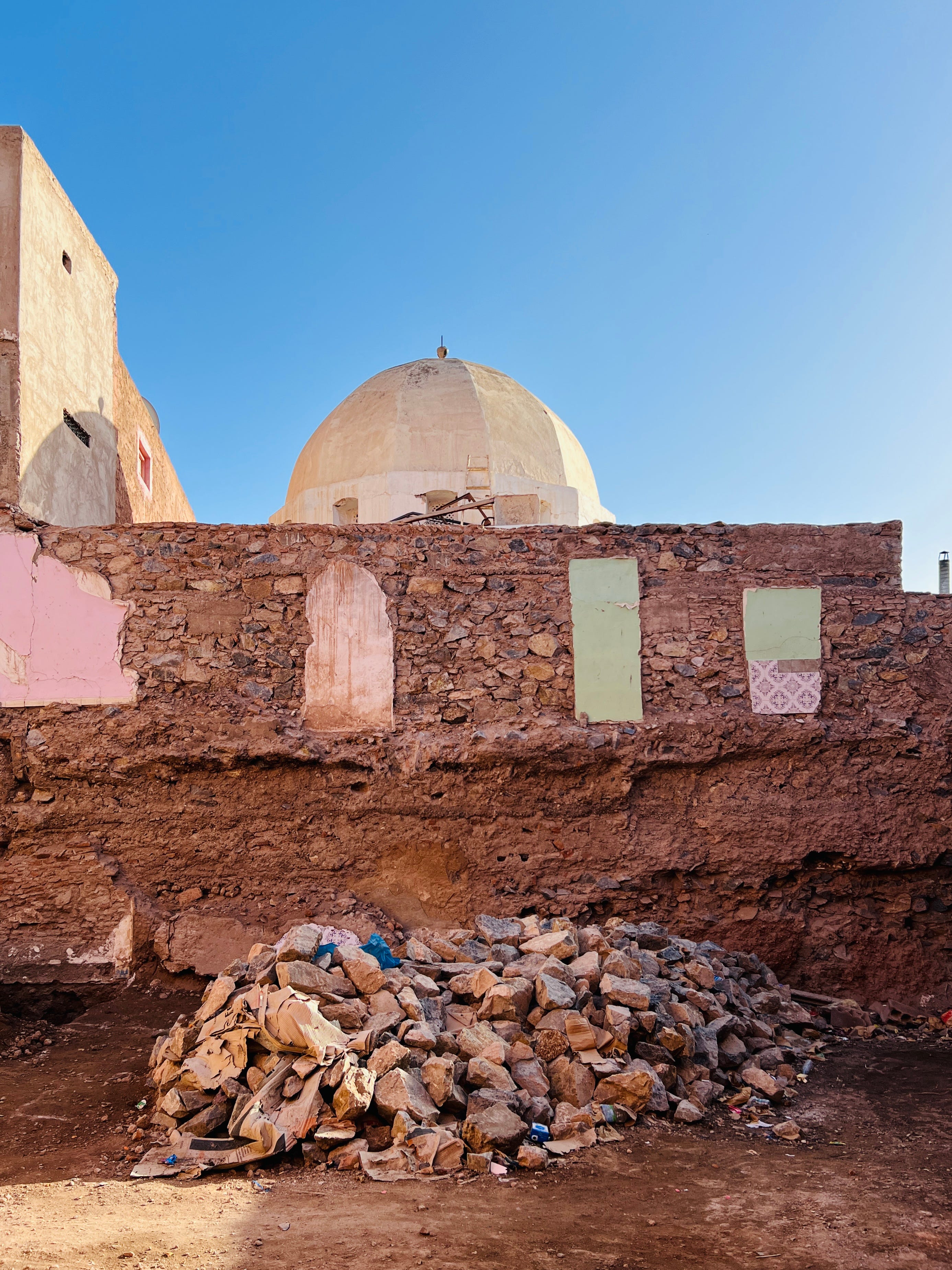
You automatically stop and try to remember what once stood here. A house with green shutters? A small shop? A courtyard with an orange tree?
In moments like these, it becomes clear that each of these buildings was its own universe. Not an anonymous volume, but a structure of voices, smells, and routines inscribed into the walls over years. Rooms full of family stories never told, yet somehow present everywhere. Children running through hallways, doors slammed too hard, a television running late into the night while somewhere dishes were still clattering. Maybe there was a table in the courtyard where people ate, argued, fell silent. Maybe a tree that bloomed every spring, no matter what was happening inside the house.
And now all of that is gone, as if it had never existed.
Every building is a universe of memories, I read somewhere recently. A sentence that sounds less like a metaphor than a statement.
And now there is suddenly only this open space.
But it rarely stays open for long.
In Marrakech, emptiness exists only temporarily. Sooner or later, everything is walled up again, built over, sealed. These in-between spaces are only a brief breath of the city before the concrete returns.
Nostalgia in the Dust
For a few weeks or months, these places turn into something strange. They almost feel nostalgic, even though they are really just absence. A kind of interim state in which the city briefly pauses before overwriting itself again.
Open spaces in the middle of dense neighborhoods, where the wind moves through, where light suddenly enters, where for the first time you can properly see the sky between two buildings. An unfamiliar perspective in a city that rarely allows space. A lightness emerges that was never planned. An openness that almost irritates, because it doesn’t belong here.
At first, only a few remnants lie scattered. Tiles still clinging to the walls, traces of paint, a doorframe without a door. Traces that haven’t quite decided whether they want to remain or disappear. But over time, the place begins to change. Gradually, the neighborhood’s waste gathers there. Old mattresses, broken plastic crates, mannequins, bags the wind presses against the walls. Things that no longer have a place elsewhere end up here.
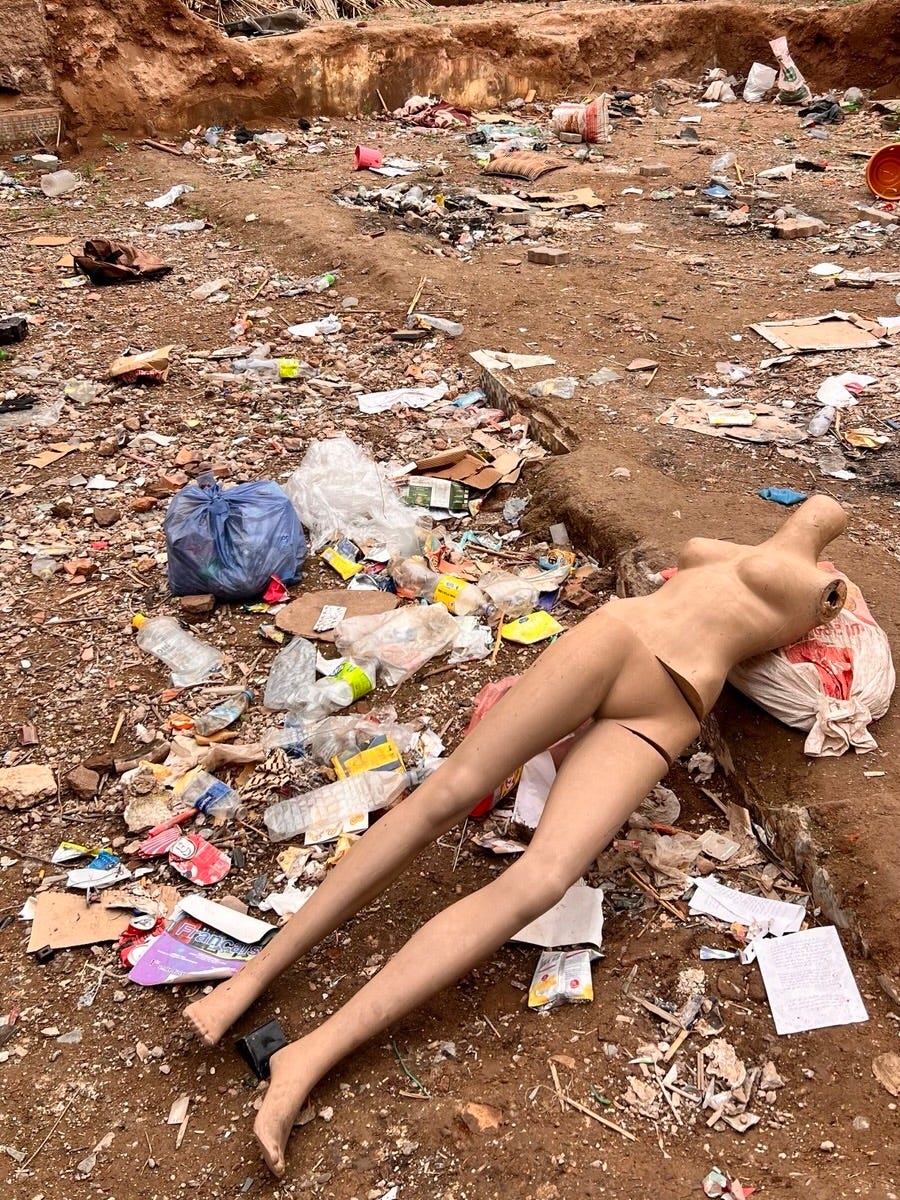
As if the city were trying to bury its own memories. Erasing it with trash. Or at least covering it up until you’re no longer sure what was once here.
And then, eventually, the construction fence appears. Cement bags. The rattling of machines. At first hesitantly, then with a matter-of-factness as if this moment of emptiness had never existed. The hole disappears again. A new building grows out of the dust, layer by layer, faster, more efficient, smoother.
Like nothing else had ever been there.
Only those who have lived here longer sometimes pause. A glance. A hesitation. A quiet calculation in the mind: there used to be another house here. And inside it, an entire life.
The houses being built now follow a different rhythm. They carry lives that do not stay. People who come, look — and borrow the city without anchoring themselves in it.
Memory and Progress
I have always been drawn to lost places. To ruins. To buildings where something has ended but not entirely disappeared. Maybe I carried that with me from a time when the country of my childhood was wiped away overnight. The end of the GDR left not only political emptiness, but very tangible spaces. Vacancy. Buildings that suddenly belonged to no one, or perhaps to everyone. A system that was meant to disappear left behind openings, cracks in the urban fabric through which you could see what had once been.
In the 1990s, these places became spaces of possibility. Squatted houses, factories turned into cultural centers, improvised stages for something that didn’t yet have a name. Places where things could develop precisely because they were unfinished, unplanned, undefined. Or do I romanticize it in hindsight? Maybe it was simply chaos. But it was a chaos that held potential.
As soon as money arrives, those spaces have to go.
This logic seems universal. Independent of systems, ideologies, or geography. Also in Marrakech.
When I walk through Gueliz, I often stop in front of these old villas that are slowly disappearing from the cityscape. Houses built for a different kind of life. Generous, with courtyards, with details that took time. I wonder who lived there. What everyday life looked like. And why these houses are abandoned and have to disappear.
Why, in the 1990s, no one could recognize the value of an old cinema. Why so many of these buildings could not be saved. Not here, not in the GDR, and probably nowhere. “Progress” tolerates no detours. It rarely arrives quietly, and even more rarely with consideration.
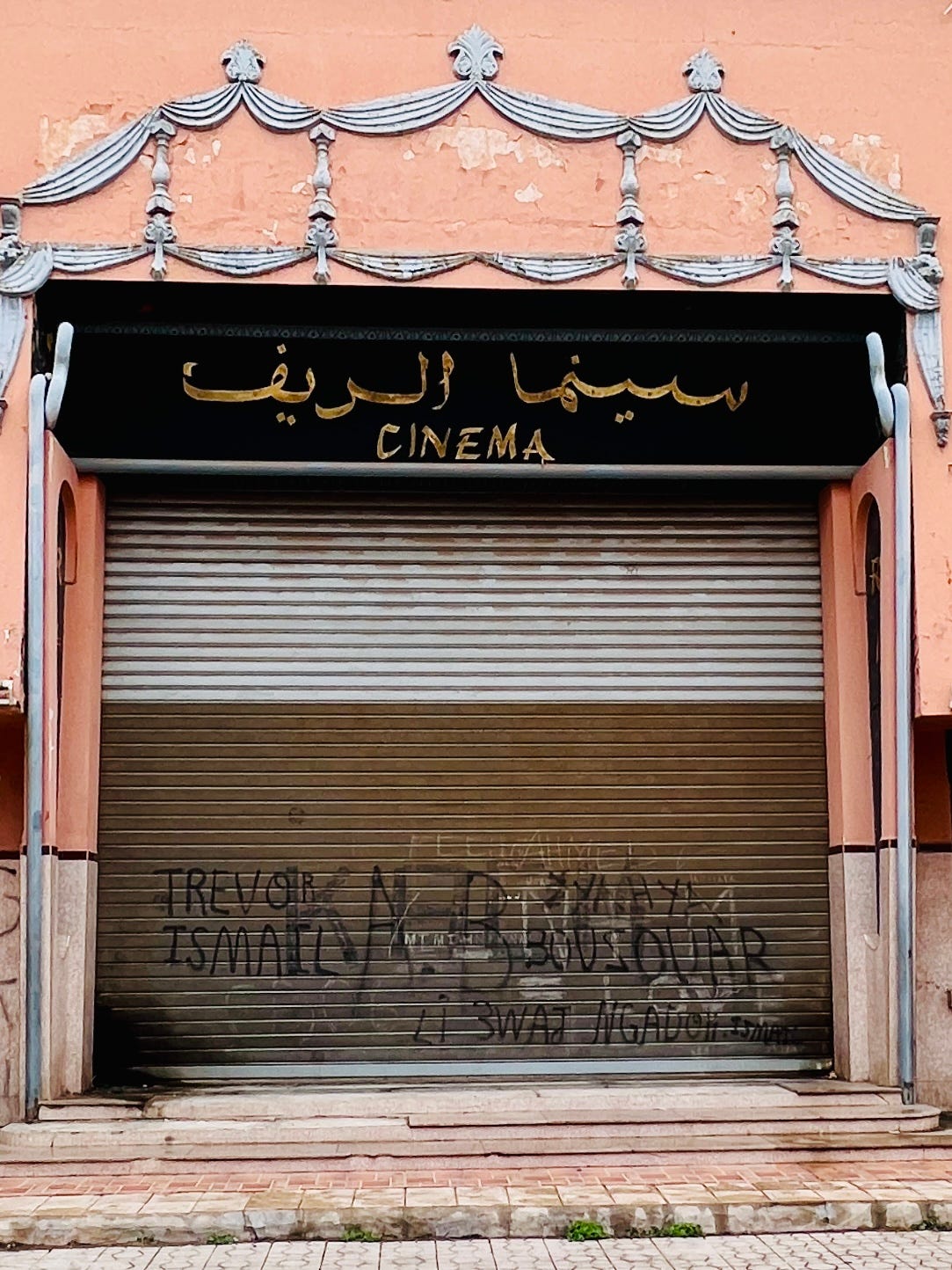
And the arrogance of supposed progress overrides nostalgia. But nostalgia cannot be defeated. It doesn’t disappear; it shifts. It settles in the gaps, in memories, in the feeling that something has been lost without being able to name exactly what it was. And it continues to feed itself — on identical city centers, on shopping malls, on facades that are interchangeable no matter where you are.
That in Morocco one dynasty built over another, that sites like the Saadian Tombs or the Koubba el-Baadiyn lay buried underground for a long time before being rediscovered, often makes my guests smile. History then appears as something that can be made to disappear for a while — until someone decides to uncover it again, depending on who holds the power to define it.
What disappears today is gone for good. We no longer build over or around things. We erase.
Money ensures that the old is completely leveled before anything new can begin. No more slow layering, no coexistence of times. Only before and after.
And when you look at the state of the world, you get the sense that learning from the past has become an outdated principle. Maybe because remembering isn’t profitable. Maybe because it’s easier to start over again and again than to confront what was already there.
The Aura of Disappearance
But these old buildings have an aura. An aura of lived lives. Something that cannot be measured in square meters and does not vanish with demolition. They carry time within them, layer upon layer, like a memory inscribed into material.
And the empty lots carry that aura forward. Perhaps even more intensely than the buildings themselves, because nothing is left to obscure it. Only traces. Fragments. Indications of something that was once whole.
Tiles still clinging to the walls, often only halfway up, above them raw masonry. Built-in cupboards, now empty, yet still shaped by the logic of a daily life that no longer exists. Remnants of a staircase leading nowhere. A wall color stubbornly holding on, as if it had forgotten that the room it belonged to has long since disappeared.
You begin, almost automatically, to reconstruct these spaces. In your mind. Who lived here? Where was the bed, the table? What voices overlapped here? And how long until these last traces disappear as well?
I remember the scars in Marrakech’s cityscape after the earthquake. How interiors were suddenly turned outward. Living rooms without a front wall. Intimacy that was no longer intimate. Ornate wooden ceilings, stucco, arches — details meant only for those who lived within them, suddenly exposed to every gaze.
You felt like a voyeur against your will looking into something that was not meant for you.
There was something painful about it. Not only because of the destruction, but because it made visible what usually remains hidden. How fragile these spaces are. How quickly they can open, break apart, disappear. It was the material form of what had been torn open in people’s lives.
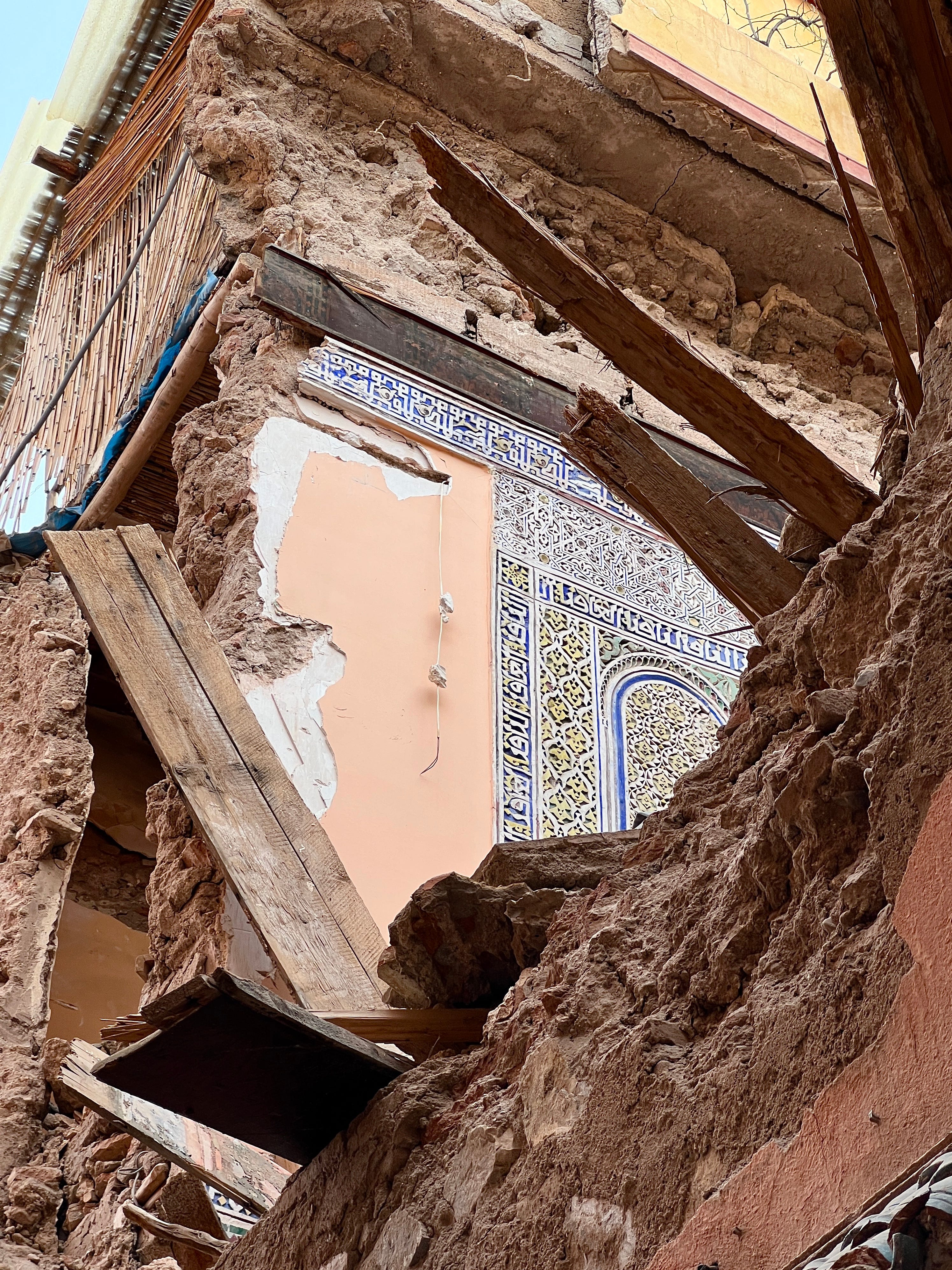
Some of these houses still stand like that today. Open. Unfinished. Like memorials to a catastrophe long past — at least for some.
The world has moved on. Tourists return. And with them, the speculators.
What Remains
When we meet the new owner of the house we (still) rent, there is no surprise. A slick type. Someone who only understands the logic of money.
Construction needs to begin quickly so the house can be rented out again as soon as possible. Each floor will be split into two units. Less space, more money.
At least from the outside, it will remain a villa.
The house that will soon have once been our home.
And Against All Odds…
And if by any chance you hear of a place for rent in Marrakech that’s still somewhat reasonable, I’d be grateful for a message.
_____
Hi, I’m Emilia – a Berliner living in Marrakech, creator of Marrakech Art Tour and co-editor of L7YOUT – Graffiti & Street Art in Marrakech (328 pages, Marrakech 2025).
Thanks for reading The Marrakech Diaries! You can support by showing me you’re here. Leave a like, a comment, spark a conversation or share this post with someone who’d enjoy it!
My PDF-Guides for independent travelers in Marrakech are available here.