
Between Art and Concrete
Marrakech 2025. Observations from a city under reconstruction

What remains when exhibitions end and buildings disappear?
A year of urban observation between art, fatigue, and resistance.
Aliens in Gueliz
My year begins in the first week of January with a tour through Gueliz. The new town: wide boulevards, Art Deco façades, the first cracks already visible. We end the tour at the gallery of Habib Kibari. The artist and gallerist opens the door exactly as I first met him there more than two years ago: hair tousled, paint on his hands. He looks tired, almost worn down, but it doesn’t take long before he comes alive. His enthusiasm transfers instantly to my guests.
He shows us this and that, pulls catalogues from shelves, leads us into the storage room where canvases are stacked, and finally into his small studio. From there you look out over the boulevard, and on clear days you can even see the Atlas Mountains behind the Koutoubia Mosque. Kibari is working on his Aliens series: humans in the age of social media. Except they are no longer really humans at all. What stare back from the canvases are grimaces—creatures driven somewhere between human, machine, and animal.
The three women in my group are enthralled. Whether it’s Habib himself, the gallery, or the art is impossible to disentangle. Back outside on the street, one of my guests—formerly a kitchen planner before retirement—starts wondering aloud what kind of houses or apartments these large-format paintings would actually fit into. Contemporary art, she seems to feel, isn’t practical enough.
At the end of January, the solo exhibition of the Aliens series opens. Ever since Habib first told me about it, I had hoped to see as many of these works gathered in one place as possible. The distorted faces form a striking contrast with the Art Deco gallery space, its floor-to-ceiling windows flooding the rooms with light.
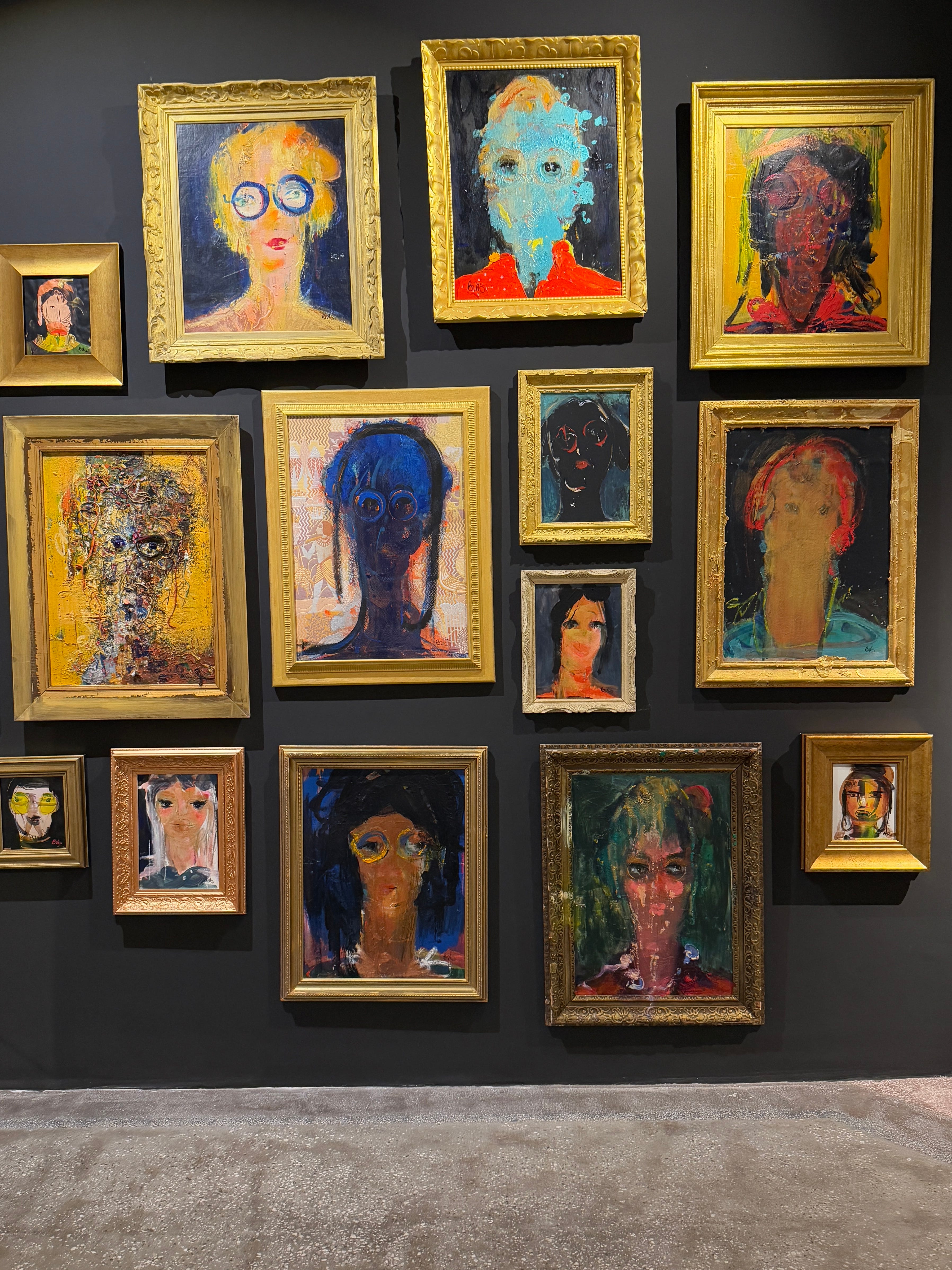
In February I return with a larger group, mostly German retirees on an art trip. The theme—social media and what it does to being human—resonates immediately. Habib’s charm is once again intact. I moderate the conversation almost like an interview, trying to translate at the same time. I ask him about his earlier works we had seen at the MACMA Museum—more figurative, less abstract. Artistic development, he says. I ask, deliberately a little provocatively, why he opened a gallery on top of being an artist, whether he wasn’t already stretched thin. A younger participant shyly asks for a selfie in front of her favorite painting. Habib agrees without hesitation.
In May, I message him just to make sure the gallery will be open the next day. His reply hits me like a punch to the stomach: he’s closed it. For good. My favorite gallery. Just gone. I stare at the message as if sheer refusal could undo it.
In July I run into Habib by chance on the street. “It’s such a shame,” I say. “Yes,” he replies, “but now I have to focus on my artistic work.” Fair enough. He tried running the gallery for two years, he says, but people only came to take photos. That wasn’t enough.
I think: Oh. I am, one more time, part of the problem.
Fairs, Fatigue, and Side Stages
The photography gallery in the same building had already closed the year before, after nearly twenty years. It still opens occasionally for special events, such as the African art fair 1–54. My relationship with that fair is ambivalent. I never quite warm to the official fair format. Even though I keep discovering interesting positions, I’m overwhelmed by the booth structure after a very short time. Art needs space. Space in the mind. But here it’s about dollar signs. What is worth how much? What will increase in value? Art as investment or décor.
I tell myself I’m not the target audience. I’m not an art buyer. Which probably makes me more of a problem than a benefit for artists—after all, no one can live off looking alone. And yet I’m struck every time by how white this art business feels, even at an African art fair. White women with MacBooks sitting in gallery booths, while African art is being sold.
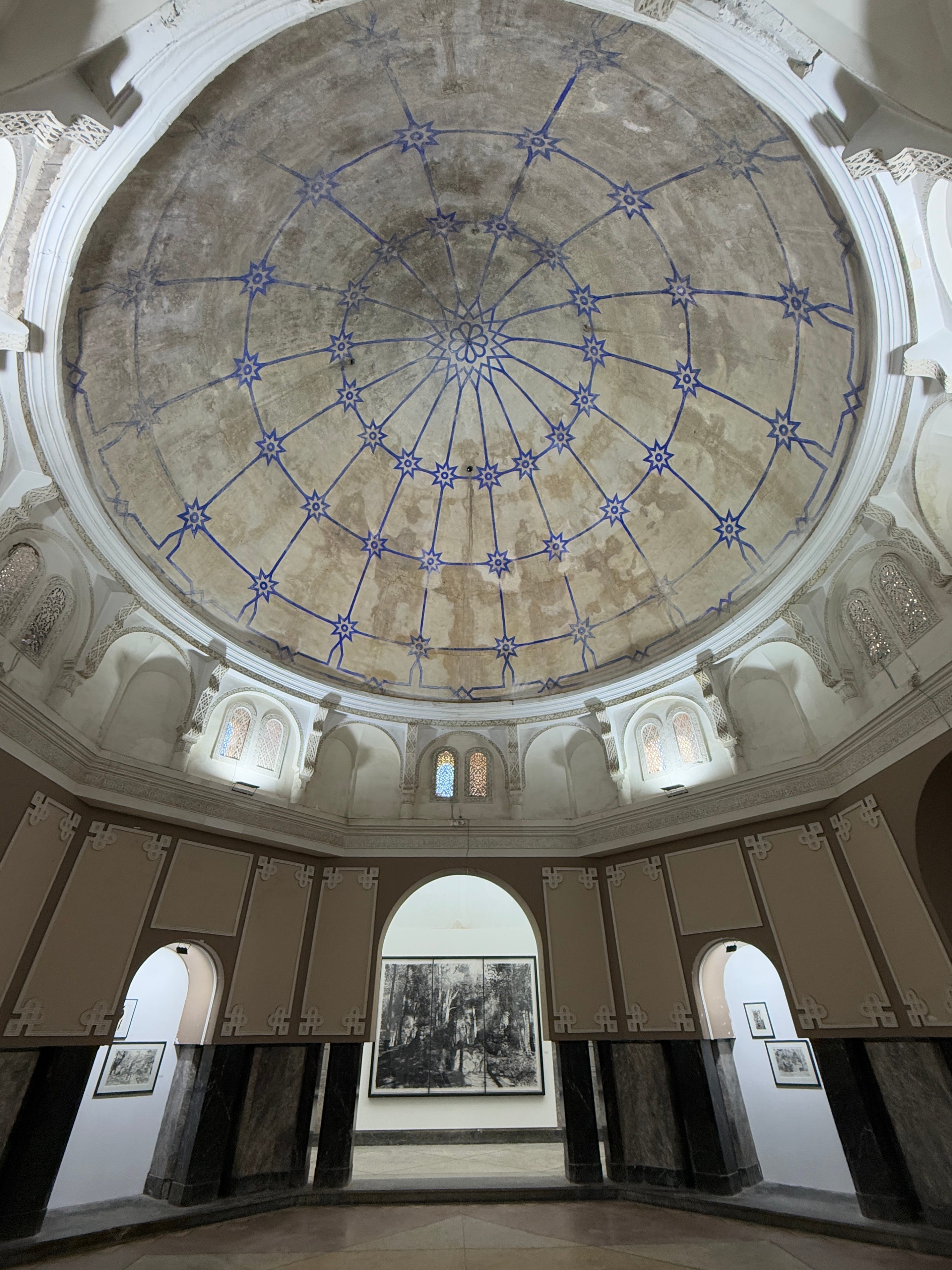
What reconciles me with the fair are the off-locations and side events. There’s an exhibition in Hammam El Bacha in the medina, a bathhouse that’s been closed for years. I’m almost stunned by how enormous it is. A massive dome. For me, it’s clear: alongside the art, the real star here is the building itself.
There’s also a lot happening at Résidence Al Hamra in Gueliz. You walk through a café thick with the blue haze of old men’s cigarette smoke into a hotel frozen in 1980s charm. Two cats sit on the reception desk. In the rooms: photographs, video installations, red velvet beds, faux leather. In the empty pool, a musician plays psychedelic music. Reverent listeners, giggling, overdressed girls, a snobbish art crowd. I drift through the floors as if time itself has stalled.
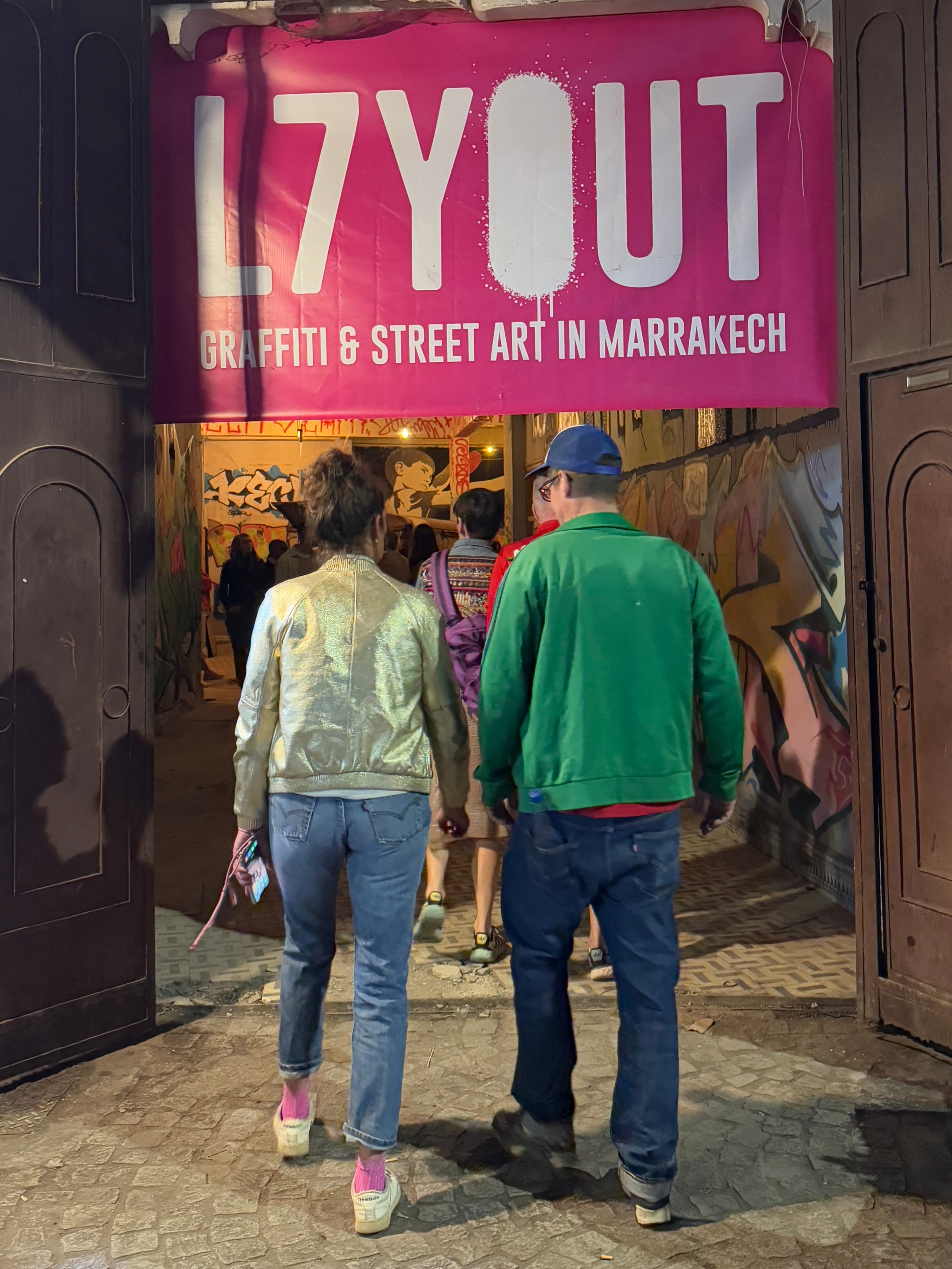
Our book launch for L7YOUT – Graffiti and Street Art in Marrakech coincides, of all evenings, with the grand opening of 1–54 at El Fenn. At the same time, we’re opening our street art gallery just a stone’s throw away. Designer dresses stumble past; some come back later. Our party is better, they say. A small victory of street credibility over gloss.
Who Owns Gueliz?
In an old print shop in Gueliz, still housing German printing machines, the design and architecture studio laberinto presents an exhibition on the history and heritage of the neighborhood. Who owns the city? is the central question. Residents were invited to write down what they wished for their district. “Cinemas,” one reads. Or simply: “Graffiti.” A ten-point manifesto calls for critical reflection on urban development, heritage, and sustainability. It questions architecture as a political statement—and how we deal with it. It couldn’t be more timely: at the same moment, new craters open up between buildings in Gueliz. Villas vanish into the dust of demolition.
One day I stop and watch an excavator push rubble aside. And then I see them: four peacocks standing on a mound of debris. They look like royal observers amid an apocalyptic landscape. Are they real? Or is the heat distorting my vision? Perhaps it’s nature laughing at us silently: Look at you, humans, with your investment projects. I pull out my phone and film, just to prove to myself later that I’m not imagining it. The Peacocks of Gueliz—a good book title, I think. Did they live in the abandoned villas and are now homeless?
A few streets away, the ground vibrates. The old Pacha Hotel is being demolished. No rescue, no plaque declaring “historic heritage.” Just dust. Places that still exist on Google Maps are already rubble in reality. Gueliz—the French-Moroccan bastard child of modernity—is crumbling. Art Deco façades disappear. Iron balconies. Ambivalence. The new city consists of glass façades, air-conditioned lobbies, concierge living without neighbors. Gueliz is meant to stop being a city.
Archives, Props, and Nostalgia on Demand
During the Journées du Patrimoine in May, organized by Turath, we choose the Gueliz tour. The square between Café Négociants and the former telegraph office is torn up. Pedestrians? Not a chance. Our guide talks about construction dates, ownership structures, and the fact that there is no functioning city archive. The fountain on the square disappears unexpectedly. Instead, the old clock tower is set to return. The fountain—where street kids and homeless people used to bathe—isn’t photogenic enough for the 2030 World Cup.
The most impressive moments are inside the stairwells of Café Négociants and Café Atlas. The handrails. The elegance. And then outside again: craters. A crane. Concrete blocks.
Later in the year, the rumor is confirmed: the clock tower is coming back. It isn’t there yet, but a banner announces it. Not quite in its original location, but close enough. Nostalgia on demand, in the middle of a freshly sealed surface.
Museums as Counter-Model
After years of renovation, Marrakech finally gets its contemporary art museum back in 2025. MACAAL reopens. The first thing you notice is the new water basin outside—a small gesture, almost too smooth for what awaits inside. The ticket desk has moved to the other side, as we realize only after entering. And yet: the same staff as before. That’s reassuring. The man even seems to recognize us. A rare moment of continuity in a city where so much is currently shifting.
It still smells of fresh paint. Of beginnings. After nearly two years of closure, the museum has only been open again for a few days. With the relaunch comes a conceptual shift: away from temporary exhibitions toward a permanent display drawn from the museum’s own collection. Seven Contours, One Collection presents works from the Lazraq family’s private collection.
At the center of the museum stands the installation Dans les bras de la terre by Salima Naji. The architect and anthropologist has built a small dome, almost like a house.
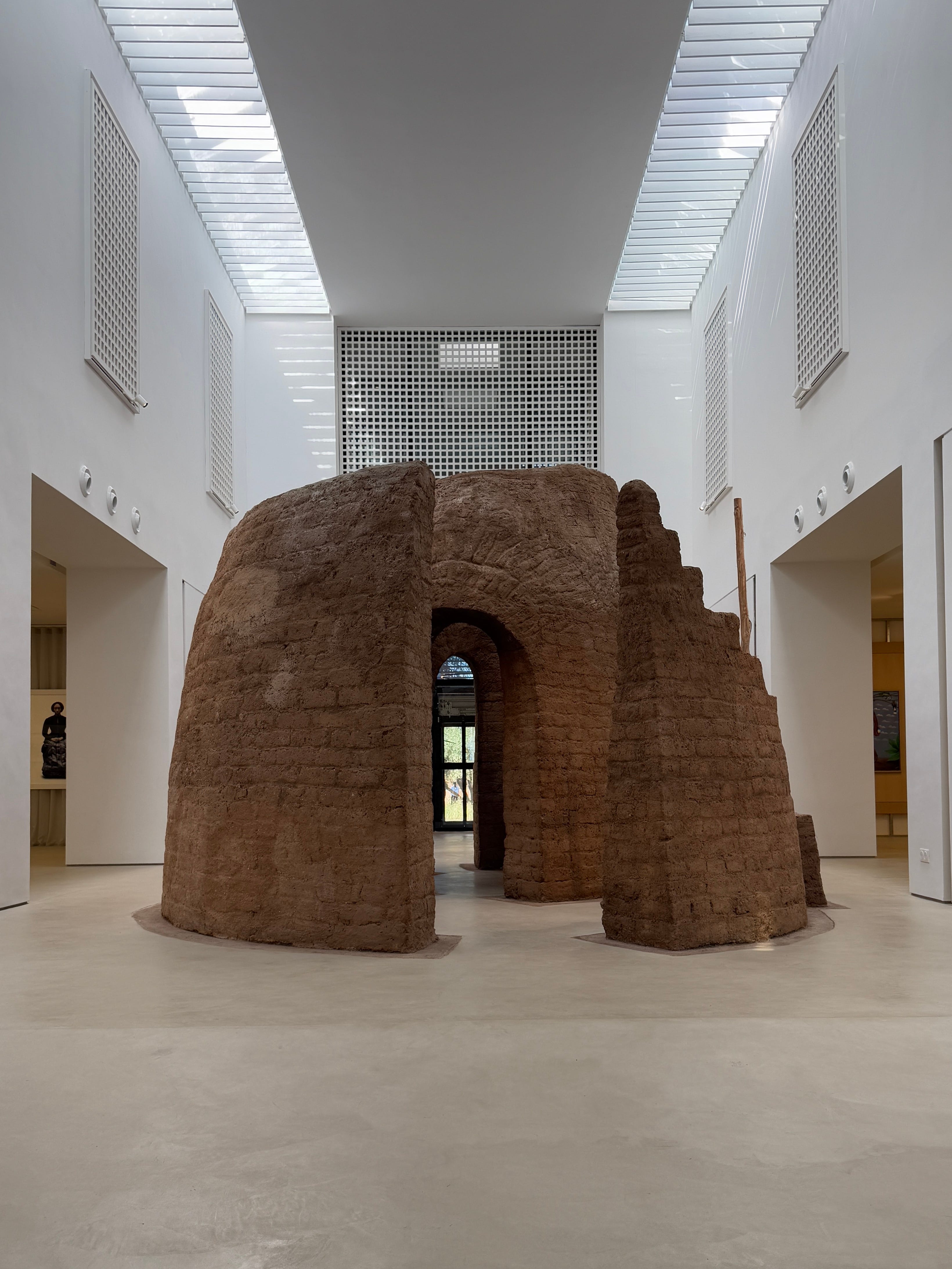
Earth-based, no concrete, wood incorporated. You step inside—and it truly feels as if the earth is embracing you. A physical sensation rare in museums. Space isn’t displayed here; it’s experienced. It’s a powerful image for what MACAAL seems to be aiming for with this new direction: thinking African contemporary art not as a short-term event, but as a continuum. Over 150 works from more than 30 countries are gathered here, many positions rarely or never shown in European museums. Painting, photography, sculpture, installation. Less spectacle, more context. And perhaps a careful but determined attempt to stop treating African art as a temporary guest in the global exhibition circuit, and instead claim it as an integral part of a global art history worthy of the name.
The relaunch of MACAAL isn’t loud, but it is firm. An institutional decision with conviction. A museum repositioning itself—not against the city, but with it. Quietly yet clearly offering a counterpoint to the endless stream of easily consumable images Marrakech otherwise produces so reliably.
Where Art Is Made
What I look forward to far more than the 1–54 art fair is the WEARTY art weekend. A relatively new initiative, first held in 2024 and returning for its second edition in May 2025—and it’s immediately clear why the format works. It doesn’t aim to impress; it aims to open doors. Alongside museums and galleries, it’s the studio visits that make the weekend compelling. Because there you encounter something that has become elsewhere: art not as a finished product, but as a process. Not as a wall display, but as a workshop. And above all: artists not as names on labels, but as people with hands, fatigue, materials, rhythms.
Abdessamia Bargamane works with metal and oxidation. I had seen his pieces some time ago at Habib Kibari’s gallery and had already resolved to look closer. His studio is tucked away in a labyrinth of workshops in the former Jewish quarter. And “labyrinth” isn’t just a nice metaphor: you genuinely stumble through passages that can’t decide whether they’re still streets or already backyards. Weld seams everywhere, sawdust, metal dust, half-finished motorcycle frames, cables, small explosions of noise. It’s easy to trip over something that’s either in the process of being built—or falling apart. Marrakech in its most artisanal form.
Abdessamia is a tall man in denim shorts, wild hair, tattoos—and that mix of dusty calm and sudden passion found only in people who truly make things with their hands. He greets us warmly, as if it were the most natural thing in the world for strangers to step into his space on a weekend. He talks about his father, who ran a small foundry, where he spent his childhood holidays. How he felt the heat of metal, its mutability—not as theory, but through touch. Metal, after all, doesn’t ingratiate itself. It’s heavy. It’s stubborn. It resists. And out of that resistance, he says, a relationship grew—one that now drives his work. He lets the metal oxidize, welds, experiments, forces it into shape until it almost becomes alive.
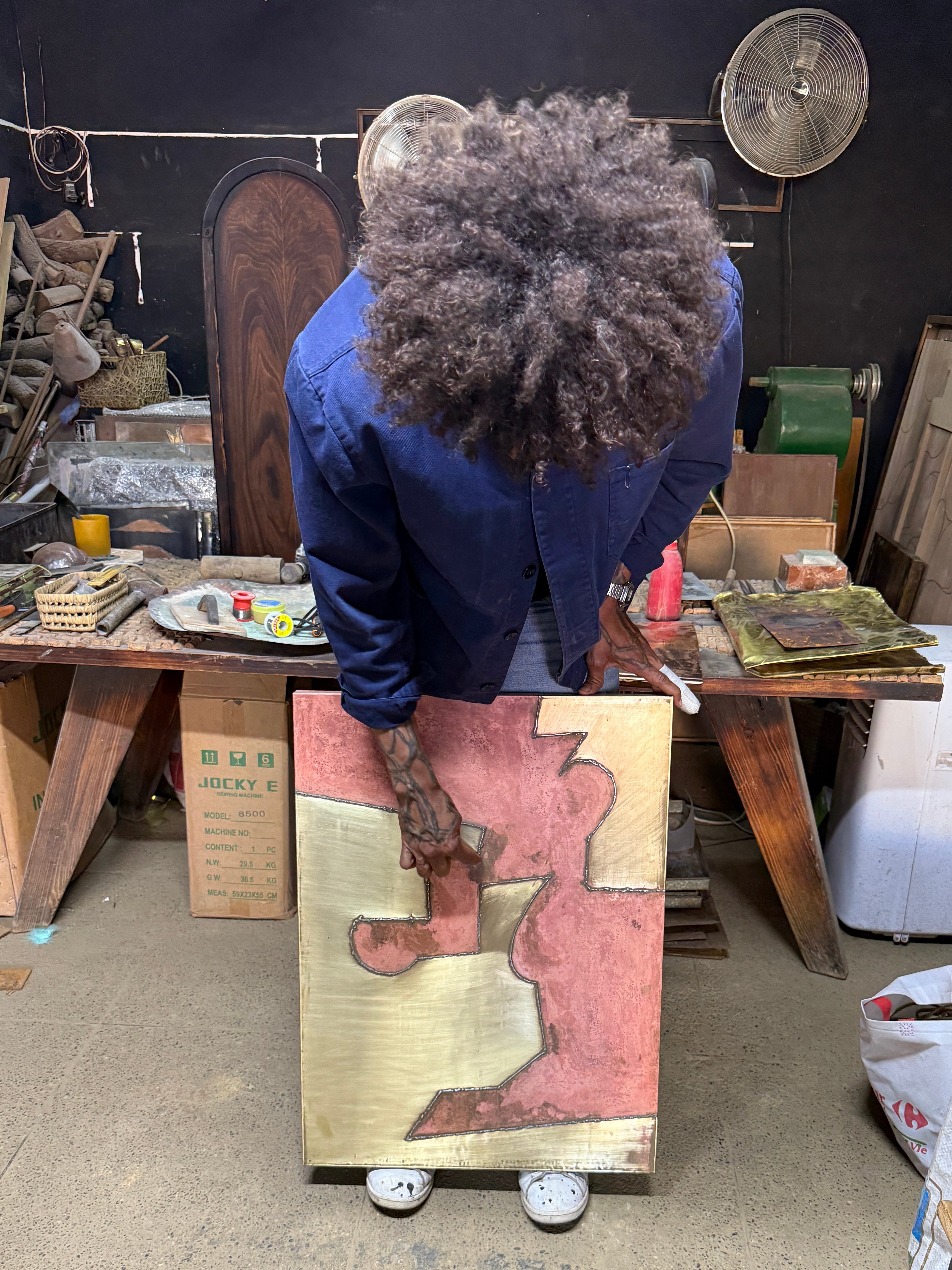
We move through his spaces like through a vertical diary: gallery on the ground floor, workshop above, another workshop on top. Metal everywhere—but not as something cold. As an organism. Rust as bloom. Oxidation not as decay, but as process, as color, as a reminder that even the hardest materials are unstable. It affects me more than I expect. Perhaps because Marrakech currently behaves in so many places as if stability were a project that could simply be “implemented”—with concrete, glass façades, renderings. Here, instead, material breathes, changes, reacts. The fusion of craft and art cuts deep, because it recalls something fundamental about the city—something too often buried beneath tourist surfaces.
Patterns Everywhere
And then there’s Mai de la Photographie. It never disappoints. On the grounds of the Institut Français, in a former military building, there’s an exhibition—or rather, many small exhibitions spread across rooms that look as if the plaster were deliberately left to peel so the art wouldn’t appear too polished. These spaces have a kind of provisional dignity, as if to say: nothing needs to be smoothed over to be taken seriously. Maybe it’s a strategy, maybe it’s just practical. Either way, it works. The rooms feel as though they’ve already absorbed stories.
What stays with me most is a room titled In the Eye of the Zebra. The photographer has collected images where zebra patterns appear in some form or another: on people’s clothes, blankets, wallpaper, billboards. Sometimes obvious, sometimes only hinted at. Together they create a visual shimmer, a kind of pattern noise that begins to feel like its own language. Standing there, I think: this series could be recreated in Marrakech at any time—not with zebra stripes, but with leopard or tiger print. The material is everywhere. Animal print here isn’t a punchline; it’s everyday life. It’s worn like a statement, without anyone needing to explain what it means.
In the basement I encounter the works of Abdelrafour Essafi. At first I’m unsure whether they’re photographs at all. Small images in wooden frames, like miniatures—scratched, color-saturated, overpainted. Essafi takes old family photos, found at flea markets, torn from albums or pulled from drawers, and works on them. With ink, pencil, scissors. He scratches, redraws, cuts, doubles and redoubles. It’s an intervention, but not the cold one of a restorer. More like someone trying to repair a memory—and realizing it can’t be repaired. Faces become masks, memories turn into small stage scenes. The people in the images look at you as though through frosted glass: close, yet without any obligation. They are there, but not for you.
Essafi doesn’t turn these faces into portraits, but into figures—roles, like on a theater stage. No longer father, mother, child, but silhouette, surface, fragment. You feel like a voyeur, aware that you’re looking into something that doesn’t belong to you. What remains is an afterimage. Not nostalgia, but disturbances, gaps, cracks. A ghost story made of found material.
Glamour, Graffiti, and the Present
Hassan Hajjaj’s new exhibition opens at the end of May at the Musée des Confluences, in the publicly accessible part of the old Pacha residence. Already at the entrance it’s clear how skewed priorities have become. Several tourist groups turn away—not because it’s too late or the museum is closed, but because they’re told the wait for a seat at Bacha Coffee is currently two hours. There’s no interest in the museum itself. Only in coffee served in a colonial setting.
I had been looking forward to this exhibition. All the more surprising, then, how indifferent it leaves me—or at least how it fails to ignite the enthusiasm I associate with Hajjaj’s work. The palace as a frame for his pop aesthetic: I’m not sure it does his art any favors. In theory, the tension is promising—tradition meets modernity, ornament meets pop, history meets the present. But the exhibition itself doesn’t seem to know what it wants to be. Photography? Fashion? Installation? Why not everything at once.
The result feels less layered than frayed. I wonder how much of it can even be read if you don’t know Hajjaj—if you don’t bring his visual language, his codes, his humor with you. And most of the tourists drifting through probably don’t. They came for the coffee. The art is just something you pass on the way there—if at all.
Visibility and Silence
In May, our L7YOUT street art gallery also closes. The owner held on longer than expected, but now it’s over. Fortunately, the NoBorder Gallery in the medina dedicates its group exhibition Sehab to the local street art scene in June. I throw myself briefly into the opening crowd and then stand there, puzzled, in front of works displayed behind expensive gallery glass like butterflies in a specimen case. Street art with its street life surgically removed. No dust. No sweat. No car horns. Sterilized for the art market.
I leave the opening quietly. Outside, the real smell of the city waits. Inside, they can go on dreaming that graffiti will one day pour itself into champagne flutes.
After the hopeful start marked by the publication of our book, the year as a whole turns out to be rather subdued for street art in Marrakech. A few paste-ups. Little that truly survives. Toward the end of the year, the city decisively reaches for the paint bucket. Walls are overpainted on a large scale, in the medina and in Gueliz alike. Some works had lasted almost a decade. Now: salmon-colored surfaces. Order must be maintained. The Interpol Summit is coming. AFCON as well. And if it isn’t the city itself, it’s the real estate bubble. A black-and-white mural of an eye—gone. Right next to it, the geometric yellow-brown work—also history. Now: construction fence. Sales office. Excavation pit. Welcome to reality.
When Generation Z takes to the streets in Morocco in October, the walls suddenly become political. Stickers, graffiti, messages. Free Koulchi—free them all. The land belongs to the people, reads a sticker beneath the image of a father with a child who has been arrested. Generation Z doesn’t need weeks to react. Three days of protest—and the street is already political.
I post images of this political street art calmly, almost matter-of-factly. Simply because it’s rare to see something like this in Marrakech. No grand statements. No text storm. Just a few short captions. It feels almost like a reflex: document, share, move on. At the time, I have no idea how much the post will hit a nerve. Shortly afterward, the algorithm goes wild. Over 5,000 likes. Reach skyrockets. Shared more than 1,200 times. The street reacts quickly. And apparently, so do people. Only official Morocco remains silent.
Survival as Performance
The film festival in November once again gives the city an extra layer of makeup. Beneath it, more street art disappears. Once Upon a Time in Gaza is showing at the Colisée. The cinema is unusually full. We manage to get two seats. Then three women sit down in front of us. Their dresses blink like Christmas trees, injected lips like duck bills, eyelashes like broom bristles. For the first ten minutes of the film, they unapologetically retouch selfies: dark circles gone, lips even bigger. Full screen brightness.
Once Upon a Time in Gaza unfolds as a film that blends Western, film noir, and dark humor—as if Tarantino had studied political science for a semester in Ramallah. At its center is Yahya, a young man who deals medication with his friend Osama—a falafel vendor with a side hustle—until the business collapses and Osama is killed. The film opens with a Trump quote imagining Gaza as the Riviera of the Middle East. Buildings explode repeatedly. Hamas tightens control. A corrupt policeman inflates his ego amid the ruins. Yahya suddenly becomes an actor in a Hamas-funded action propaganda film.
Given the current situation, the film may seem almost flippant. And yet, between the lines, it’s about resistance, images, staging. About survival as performance. And about revenge—or what remains of it when you can no longer tell whether you’re acting in a film or living in reality.
At first, I’m not sure what to make of the film. It leaves me undecided. Perhaps it’s the split structure, the mixture of slapstick and trauma. But something sticks. Maybe it’s the characters—so exhausted by life, yet continuing anyway, until they can’t.
After the credits, thunderous applause. The directing duo, the Nasser twins, come on stage. Tarzan and Arab—actually Ahmed and Mohamed—hard to tell apart. Both dressed in black, silver jewelry, eyeliner, full beards, slicked-back hair. They talk about the production, which sounds almost as absurd as the plot itself. And about resistance through images.
What Remains—and What Is to Come
This year was full of closures, demolitions, fatigue. Galleries vanished. Buildings fell. Walls were painted over. Much of it felt like things were becoming quieter, flatter, more interchangeable. And yet there were those other moments. Moments when art, architecture, and the city briefly flared up and reminded me why Marrakech is more than a backdrop for passersby. Not as spectacle, but in passing. In a studio hidden behind an unremarkable door. In a stairwell that still tells of another time. In a wall that suddenly says something—before disappearing again.
This city isn’t livable because it’s perfect—but because of its friction. Because of things that don’t resolve. Because of people who stay, even when it’s exhausting. Because of artists who keep going, even when no one buys. Because of streets that refuse to be smoothed out completely, no matter how many layers of paint are poured over them. Marrakech doesn’t live off grand gestures, but off the sum of small acts of resistance.
For the new year, I wish for less makeup and more substance. Less eventization, fewer choreographed experiences. More everyday life instead. More spaces where art can exist without being immediately consumed, rated, or photographed. Places that don’t explain, but endure. A city that takes itself seriously—not as a product, but as a place to live.
Marrakech will probably not be saved. But it will continue to evade, to rearrange itself, to contradict. It will lose things and unexpectedly preserve others. Perhaps that is its greatest quality: that it cannot be definitively fixed. That it remains uncomfortable. And that you cannot simply own it, just because you’ve been here once.
_____
Hi, I’m Emilia – a Berliner living in Marrakech, creator of Marrakech Art Tour and co-editor of L7YOUT – Graffiti & Street Art in Marrakech (328 pages, Marrakech 2025).
Thanks for reading The Marrakech Diaries! You can support by showing me you’re here. Leave a like, a comment, spark a conversation or share this post with someone who’d enjoy it!
My recently updated PDF-Guides for independent travelers in Marrakech are available here.