
After the Final Whistle
Morocco Between the Streets, the World Stage, and Everyone Else's Projections

Three tournaments. Countless evenings in Marrakech cafés. A city holding its breath before kick-off—and erupting after the final whistle. An attempt to understand why football here tells a story far bigger than the game itself.
Somewhere, Someone Is Always Playing
In Marrakech, you don’t need a football pitch for a match to begin. Two stones make a goal, a wall becomes the touchline, a stretch of road turns into a field. Sometimes you don’t even need a proper ball.
Somewhere, someone is always playing: outside schools, on dusty vacant lots, between parked mopeds, and in the narrow alleyways of the Medina, where you occasionally have to duck because a ball comes flying at your head out of nowhere.
The city doesn’t just play football in stadiums or packed cafés. It plays it in the middle of everyday life.
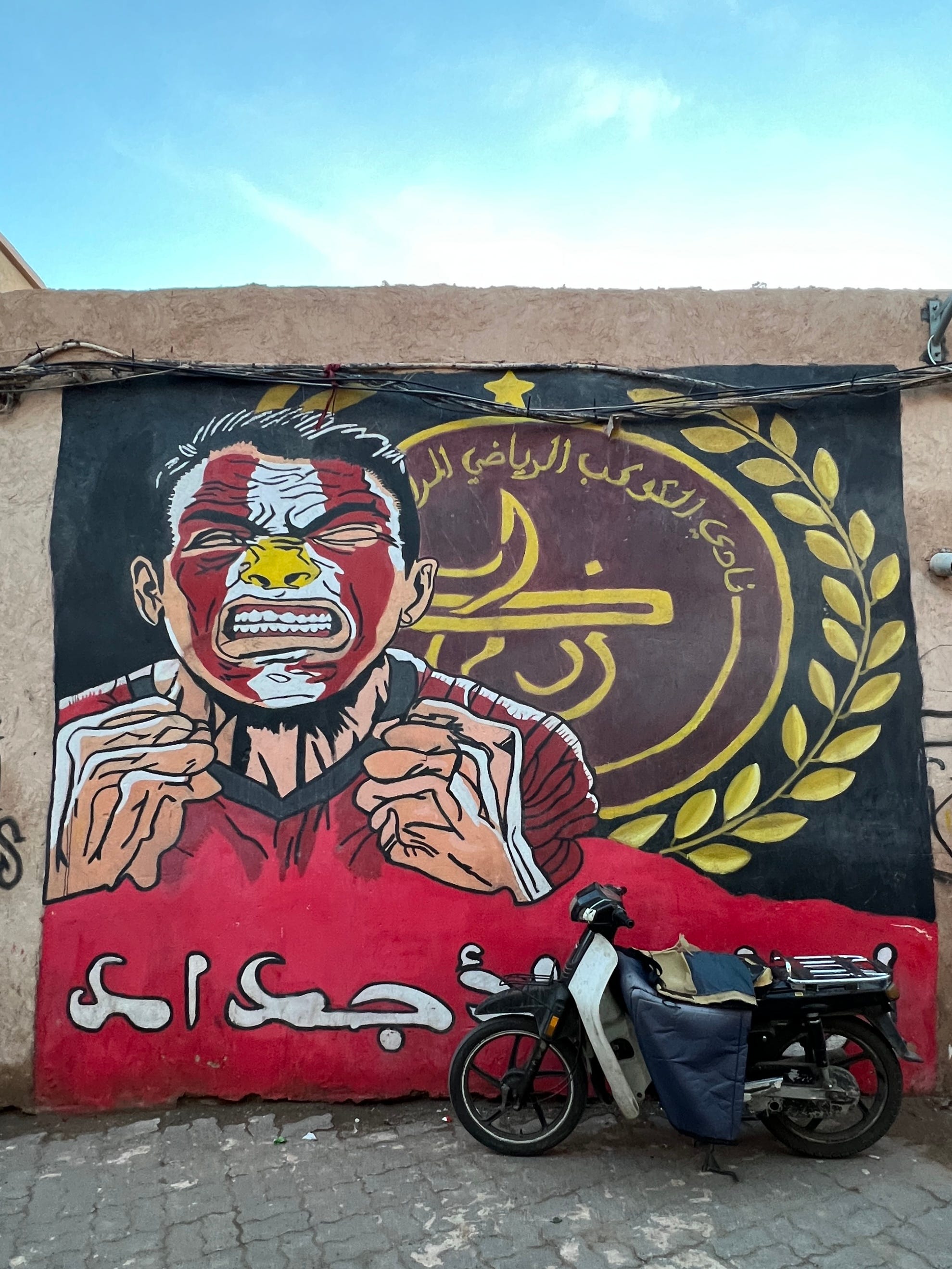
You can see how deeply football runs through Marrakech just by looking at its walls. Red, black and white murals dedicated to the city’s football club, KACM, cover facades, walls and entire streets—players, club crests, founding dates, scenes from the games, declarations of love for the team.
In a city where murals often disappear almost as quickly as they’re painted, these are among the few that somehow survive. Perhaps out of respect. Perhaps out of superstition. Or perhaps nobody wants to pick a fight with a football wall. Here, devotion to the club seems to enjoy its own invisible heritage protection.
I'm not exactly football-mad myself. At least that's what I believed for a long time. My interest stretches as far as major tournaments, big games and the kind of half-knowledge acquired through family. My father is the real football fanatic. I probably learned just enough from him to know when a match is about to turn—and too little to protect myself from the madness that follows.
Even so, I never imagined that during the 2022 World Cup I’d find myself crouched on a plastic chair in overcrowded cafés in Marrakech, rubbing a Union Berlin (a club from my hometown) emblem on what had somehow become a lucky jacket and sending desperate prayers to a football god I only believe in when Morocco is playing.
Something about this team changed me. Not just my afternoons or my nervous system. It changed the streets.
Players became points of reference. A surprise tournament became a story about representation. And for a few extraordinary weeks, a country the world had mostly overlooked—or reduced to familiar clichés—became the centre of the footballing universe.
No One Ordered This Story
Some stories are written as hero’s journeys from the very beginning. Others become one in spite of every expectation. Morocco’s story in 2022 belonged firmly to the second category.
It’s easy to forget now how improbable that success really was. Four years later, it almost feels as though Morocco has always belonged among football’s major nations. As though Bono, Saïss and Regragui had always featured on jerseys, billboards or international football debates. They hadn’t.
When the World Cup in Qatar began, hardly anyone was talking about Morocco. The favourites were Brazil, France, Argentina. Maybe Belgium. Morocco was considered a decent side—certainly not one expected to make history.
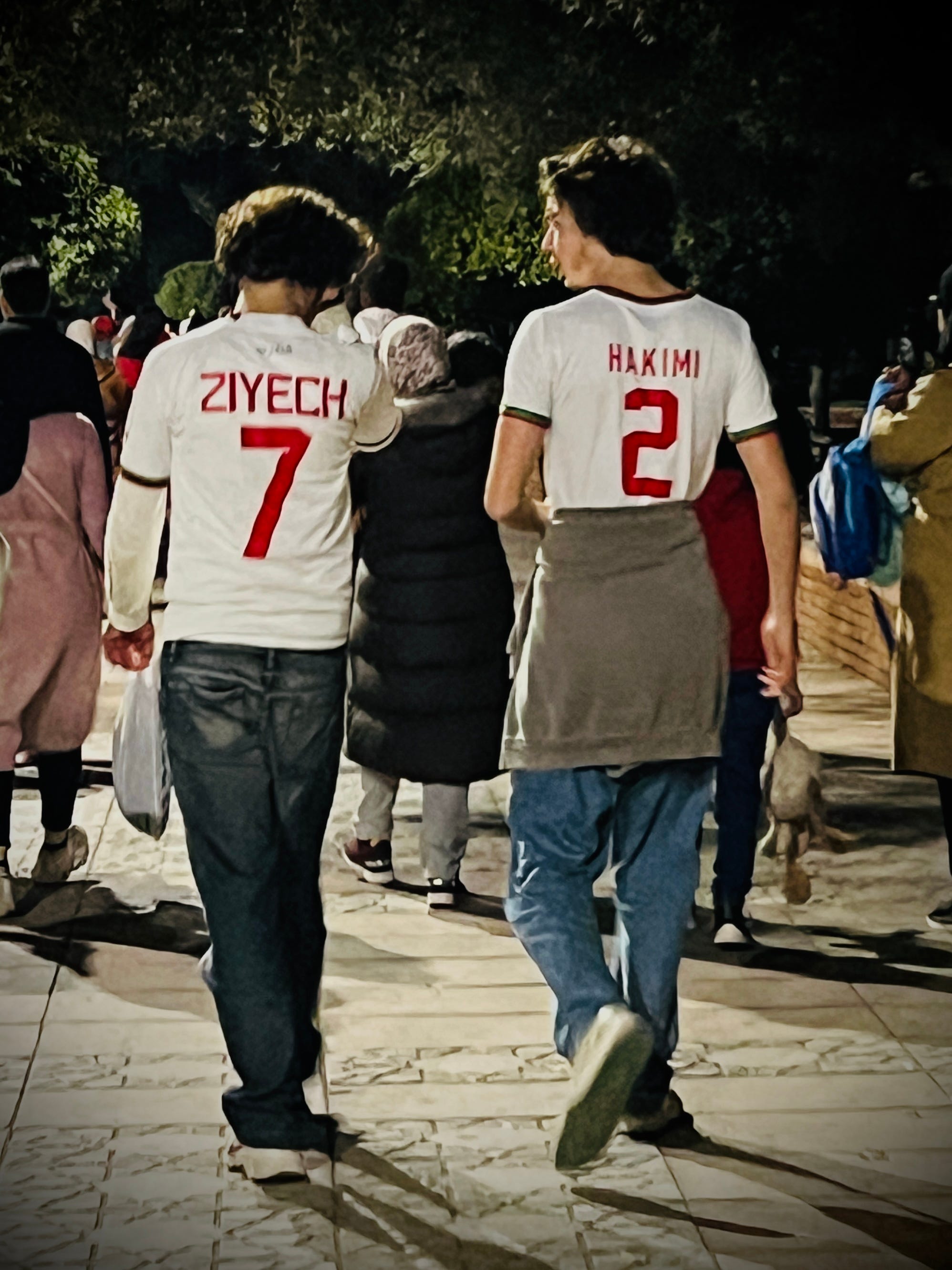
You could see that in Marrakech, too. In the souks, jerseys of international clubs hung from the ceilings. Messi. Ronaldo. Mbappé. If you wanted a Moroccan national team shirt, you would usually find Hakimi or Ziyech.
Bono? Nowhere. The goalkeeper who would become a national hero only weeks later barely existed on the market stalls.
Then came Belgium. We watched the match from the sofa while, outside, Marrakech seemed to hold its breath. Morocco fought. The first goal went in—only to be ruled out for offside. Then, finally, relief. One-nil. A second goal followed just before full time. Before we’d even switched off the television, we could already hear them: the horns from cafés echoing across the entire city. We walked towards the Koutoubia Mosque. Motorbikes circled the roundabout, horns blaring. Flags fluttered overhead. Balloons drifted into the night sky. The whole city had become one enormous improvised victory party. And with every match, it grew.
When Morocco knocked Spain out on penalties, the cook in the restaurant where we were watching kissed the tiled floor after Bono’s first save. Nobody laughed. Nobody found it excessive. Everyone understood.
After the victory over Portugal, the waiter of the restaurant cried in the arms of a colleague. On the television, Cristiano Ronaldo was crying too. No one seemed to be comforting him.
Outside, complete strangers threw their arms around one another. Shopkeepers picked up drums.
Ceremonial horses, motorbikes, children, grandparents, tricycles, cars, vans—everything with legs, wheels or hooves appeared to be out on the streets. The whole city was moving at once.
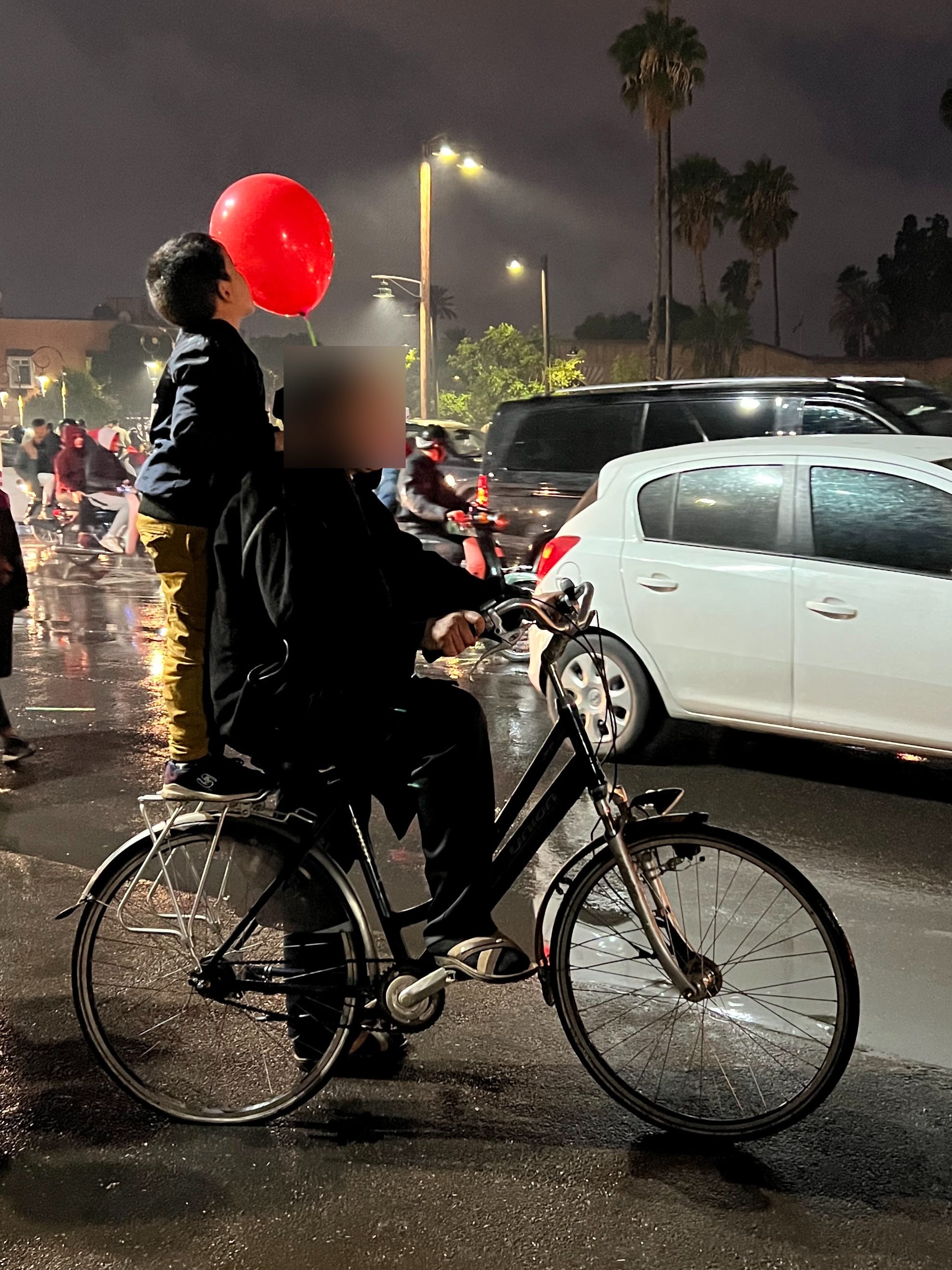
After another match, I saw a little boy standing on the luggage rack of his father’s bicycle. He was holding a Morocco balloon. Again and again he pulled it close and kissed it. Those are the images that stay with you.
At some point, it stopped being just football. With every match, something changed—not only on the pitch, but throughout the city.
Names that hardly anyone had wanted printed on shirts only weeks before suddenly appeared everywhere.
Bono became more than a goalkeeper. He became a myth.
Regragui became more than a coach. He became a father figure.
You could watch representation materialize in real time.
I realized, what fascinated me wasn’t just football itself. It was what football does to a society. The way every generation suddenly begins speaking the same language. The way cafés become theatres. The way entire neighbourhoods fall silent at exactly the same moment. And the way a city explodes after the final whistle, as though it had been holding its breath for ninety minutes.
Suddenly it wasn’t only a football team that was winning. It was a country that had usually been cast as an extra in football’s grand narratives. An African team. A squad whose players had mostly been born or developed in Europe, yet somehow told a completely different story about belonging.
And suddenly everyone wanted to be part of that story.
Arab, African—and Amazigh?
With Morocco’s sporting success came another story. One that wasn’t unfolding on the pitch, but in headlines, television studios and comment sections.
Only a few months earlier, during the Arab Cup, people had seriously debated whether Moroccans were “really” Arab.
The moment Morocco became the first African team ever to reach a World Cup semi-final, headlines around the globe suddenly proclaimed: the first Arab nation to reach a World Cup semi-final. It was as though success hadn’t settled the question of identity—it had only intensified it. Success makes you visible. But visibility doesn’t necessarily mean being seen.
No sooner had Morocco won than the international sorting began. Arab or African? As though a country had to choose. As though a nation shaped by Amazigh cultures, Arab influences, African connections, the Mediterranean and the Atlantic could somehow be reduced to a single identity. The Amazigh dimension almost disappeared from the international narrative. Too complicated. Too layered for the logic of a headline. Too unfamiliar for an audience that prefers clear-cut categories.
And yet Morocco has been telling a different story for centuries—one in which identities don’t sit neatly beside one another like labelled drawers but overlap, merge and coexist. Arab. Amazigh. African. Muslim. Mediterranean. Influenced by Europe. None of these layers explains the country on its own.
Perhaps that also a reason why this team resonated so deeply across the world.
It was celebrated simultaneously in Rabat and Dakar, Cairo and Paris, Amsterdam, Brussels and Montréal. African media hailed it as a triumph for the continent. Arab broadcasters celebrated a historic moment for the Arab world. Across Europe’s diasporas, the team became a symbol for a generation no longer willing to choose between heritage and the lives they had built elsewhere. All of those readings can be true at once.
At the same time, parts of the Western media were telling a very different story. Rather than focusing solely on pressing, tactics and footballing intelligence, coverage repeatedly drifted towards religion, culture and family. The raised index finger—the tawhid gesture—with which several players celebrated their goals was often hastily associated with Islamism. The embraces between players and their mothers after matches were widely admired, yet also treated almost as an anthropological curiosity. As though there had to be an explanation for why men from a society so often reduced in Western discourse to clichés about misogyny would openly show affection for their mothers. It was as if a Moroccan team couldn’t simply be excellent at football. It also had to be interpreted. Categorised. Explained.
Perhaps that widespread appropriation was both the greatest compliment—and the greatest irony—of the entire tournament. Suddenly everyone wanted to explain who this team belonged to.
In truth, it belonged first and foremost to itself. And to the people of Morocco, who had been chasing stray footballs through alleyways long before anyone else had started paying attention.
The Weight of a Miracle
The 2022 World Cup changed Morocco. Not only the way the team saw itself, but the expectations of an entire country. The underdog had become a favourite.
Suddenly it was no longer enough to compete. Morocco was expected to win.
You could feel it weeks before the 2025–26 Africa Cup of Nations had even kicked off. In cafés, people were no longer asking whether Morocco might make a deep run—they were debating who they would meet in the final.
The euphoria of 2022 was still there. It had simply lost its innocence.
You could see it before a single ball had been kicked. Four years earlier, cafés had dragged televisions onto their terraces and hoped for the best. Now they had transformed themselves into fully fledged fan zones. Red-and-green bunting stretched across outdoor seating areas. Life-sized cardboard lions welcomed customers at the entrance. Giant screens had been installed. Seats could be reserved. Some cafés even charged admission. What had once felt improvised had become an industry.
We were back on plastic chairs in front of giant screens. Once again, the streets emptied at kick-off. Once again, finding a seat became a challenge in itself.
Outside the cafés, however, a very different conversation was unfolding. While billions were being invested in stadiums, infrastructure and prestige projects for the Africa Cup of Nations and the 2030 World Cup, young Moroccans were taking to the streets to protest unemployment, soaring living costs and shrinking prospects for the future. Football had long ceased to be just football. It had become a national project. National pride and social reality were suddenly running alongside each other.
Perhaps that was what made this tournament so much heavier.
In 2022, Morocco had been allowed to surprise the world.
Now it was expected to deliver.
The pressure seemed to occupy every empty chair. It sat with us in the cafés, on the terraces, between rows of plastic seats where hundreds of people watched each match as though far more than ninety minutes of football were at stake.
During the 2022 World Cup, every victory had felt like a gift. Now every victory felt expected.
And every draw already resembled a minor crisis. After a string of unconvincing performances, people were openly asking whether Walid Regragui should resign. The same coach who had taken Morocco further than any African team in World Cup history suddenly found himself defending his position after a sluggish match against Tanzania. Football can be astonishingly ruthless.
Success doesn’t simply raise expectations. It erases yesterday’s achievements faster than anyone imagines.
Objectively, Morocco still made history. The team reached its first Africa Cup final since 2004. Once again, cafés became theatres. Once again, an entire city seemed to stop breathing whenever Bono faced another shot.
And then came the final. One of those matches after which nobody talks about tactics anymore. Brahim Díaz missed a Panenka penalty. The referee became part of the story. At one point, the opposing coach even ordered his players off the pitch.
Chaos replaced football. What I remember most isn’t the scoreline.
It’s the faces. Díaz, who only moments earlier had embodied hope, suddenly wore the expression of someone convinced he had let an entire country down. Bono was named the tournament’s best goalkeeper, yet the trophy looked almost meaningless in his hands. Regragui stood silently on the touchline while journalists were already asking whether his time was over.
Perhaps that’s football’s greatest cruelty. It creates heroes. But it rarely allows them to remain heroes for very long.
By any reasonable measure, the tournament had been a success. A final. Morocco’s best AFCON performance in more than two decades. And yet it felt like failure. Because expectations write their own script.
In 2022, Morocco had surprised the world. In 2026, it seemed capable only of disappointing itself.
A miracle cannot be repeated. It can only evolve.
That might be the reason this team needed a new beginning. Not because it had failed. But because, in football, success can become the heaviest burden of all.
Never Just Football
Morocco was eventually declared the winner of the Africa Cup of Nations after the final was overturned. Officially, the trophy changed hands. Emotionally, it never really did. The images that stayed with people were different: the chaos, the missed Panenka, the lengthy interruption, the silent cafés, the tears. You can rewrite the record books. You cannot rewrite how an evening felt.
And then Regragui was gone. Perhaps it made sense from a sporting perspective. Perhaps every team eventually needs a new voice. Perhaps expectations had become so immense that even the coach who had taken Morocco further than any African side in World Cup history could no longer be protected by past achievements. Still, something in me resisted the change. Not for tactical reasons, but sentimental ones. You want the people who shaped a particular feeling to stay. The same coach. The same players. The same faces. As if keeping everyone in place could somehow preserve 2022. But football refuses to stand still.
By the time the 2026 World Cup began, even the weather told a different story. The tournament of 2022 had been played through rainstorms, cold evenings, lucky jackets and cafés with fogged-up windows. Now Marrakech was in full summer mode. Forty-five degrees. Heat was no longer weather; it was a permanent condition. The asphalt radiated it back, the walls radiated it back, even touching a car door felt like grabbing a hotplate.
The team looked both familiar and unfamiliar. Hakimi was still there. Bono too. Many of the faces the country had grown attached to remained. But on the touchline stood Ouahbi. I found myself missing Regragui immediately, though that is hardly a scientifically sound football analysis. It was more a question of presence. Regragui had always struck me as someone capable of reading a football match while simultaneously settling a family argument. Ouahbi felt more distant towards the players. Perhaps that was unfair. Perhaps I simply wasn’t ready to admit that one chapter had ended.
Against Brazil, I noticed how much my own expectations had changed. Morocco started brilliantly. For twenty minutes it genuinely looked as though Brazil had no answer. Then came a stunning Moroccan goal, and I caught myself thinking: maybe Brazil really are there for the taking. Maybe Morocco has reached the point where simply competing is no longer enough. Ten minutes later Brazil equalised.
Suddenly Brazil looked like Brazil again—quicker, calmer, inevitable. Morocco held on, Bono rescued what he could, and the match finished level. Four years earlier I would have celebrated a draw against Brazil as another historic achievement. This time, it felt strangely unsatisfying. I wanted more.
Perhaps that is the longest-lasting consequence of what the world called Morocco’s miracle. Not only do others see this team differently. Morocco does too. And, somewhere along the way, so do I.
A few matches later we found ourselves in a café on one of Marrakech’s main avenues for the game against Haiti. I had arrived early, carefully inspecting viewing angles, screens and empty chairs. The café was called Showtime—a name either perfectly suited to football or slightly too confident. The waiter ignored me almost completely. There was no mint tea anyway. A café in Marrakech without mint tea felt almost unconstitutional.
Before kick-off I was unusually relaxed. Haiti were considered outsiders. What could possibly go wrong?
After ten minutes Haiti were leading. The ball had bounced off Bono’s back and into the net. The café fell into that peculiar silence that only happens when everybody realises, simultaneously, that reality has ignored the script. Morocco equalised, fell behind again, equalised once more. Later I would read that it had been one of the tournament’s most thrilling halves. At the time it felt less like great football than a medical condition: racing pulse, unbearable heat, misplaced passes, no mint tea, and the growing suspicion that somewhere above us someone was adjusting the plot for dramatic effect.
Morocco eventually won 4–2. Marrakech celebrated. But the relief sounded different from 2022. Back then it had been amazement. This time it felt more like escaping a disaster that should never have happened in the first place.
The Netherlands match kicked off at two in the morning. We were too exhausted to find an open café and ended up watching on a laptop at home. The Dutch took the lead in the 71st minute.
“That’s it,” I hear. “We’re out.” And I almost believed it. Then, in the ninety-first minute, Morocco equalised.
“It’s a goal! It’s a goal!” I shouted, crying.
The match went to penalties. Hakimi—of all people—missed. Bono saved one. The Dutch missed again. Saibari stepped up to take the decisive penalty.
Marrakech fell completely silent. And then the call to prayer began. Saibari scored.
For one brief moment everything existed at once: football, the middle of the night, exhaustion, tears, the adhan echoing across the city, and overwhelming relief. An entire city seemed to inhale and exhale in exactly the same second.
One more time it became impossible to pretend football was just football.
By then, it had become a place where everything else seemed to surface. Things that had little to do with tactics or scorelines: memory, identity, expectation, politics. For ninety minutes, they all converged on a single pitch.
And then came France. Again.
Whenever Morocco play France, more than eleven players take to the field. Standing on the touchline are colonial history, migration, language, diaspora and all the ties that cannot be reduced to two opposing teams. Families live across both countries. Players have grown up in France before choosing Morocco. Millions of people belong, in one way or another, to both places. That is precisely why the fixture resists easy symbolism. It is not simply coloniser versus colonised. Reality is far more entangled than that. But neither is it ever just another quarter-final.
France had ended Morocco’s dream in 2022. Four years later, the same unfinished story returned. I arrived at the café two hours before kick-off to secure a seat. The circle had closed. We were watching in exactly the same place where we’d seen Morocco’s first match of the tournament. Only this time nobody wanted to sit outside. It was simply too hot.
When I arrived, the mezzanine was empty. Front row. Perfect. For a while I sat alone facing the giant screen, as though I had personally organised the World Cup quarter-final. Gradually the room filled with red shirts, plastic chairs, anxious conversations and rising temperatures. Ten minutes before kick-off, the room had become less of a café than a human pressure cooker.
As the teams walked out, I had an immediate bad feeling. The red shirts. Every time Morocco play in red instead of white, they seem to lose. There is no statistical evidence for this whatsoever. It is simply football superstition—one of the sport’s most reliable currencies. Lucky jackets. Lucky seats. Things you must never say aloud. Rituals everyone knows are irrational and obeys anyway.
Morocco weren’t terrible. They were hesitant. It felt as though someone had quietly removed their belief before kick-off. The passes were cautious, the movement lacked conviction, clear chances never really appeared. France weren’t spectacular. They simply looked ready. Then Bono saved a penalty from Mbappé.
The room exploded. For a few glorious seconds, a saved penalty felt exactly like a goal. A brief refusal to accept that history was repeating itself. But it remained only a moment.
Everyone kept waiting for something to change. For Hakimi to break free. For one impossible pass. For one piece of footballing destiny. Instead France scored twice.
People started leaving before the final whistle.
Perhaps that was the most honest kind of defeat. There was no controversial referee, no missed Panenka, no VAR conspiracy to cling to. France were simply better—or perhaps simply calmer when it mattered. Morocco lost the match without losing its dignity.
That is why this team should never be treated merely as a symbol. Footballers are not national metaphors wearing boots. They are people. They get tired. They make poor decisions. They miss chances. They misplace passes. They miss penalties. Sometimes there is simply nothing they can do. Bono cannot save every shot. Hakimi cannot rescue every match. No coach can preserve a miracle forever.
Perhaps what was true in 2022 is still true today: you don’t have to finish first to have won. But you also have to be allowed to lose without everything that came before suddenly becoming worthless.
Back To The Streets
By the time we leave the café, the city has cooled down. For the first time in days, the night temperature has dropped below twenty degrees. After weeks of forty-five-degree heat, shimmering asphalt, poorly air-conditioned cafés, plastic chairs, red polyester jerseys and collective football anxiety, there is finally air to breathe.
The spell has broken.
The vuvuzelas have fallen silent. Only the occasional motorbike still rattles past. A city that had spent weeks holding its breath suddenly seems exhausted by itself.
In 2022, we walked home through a storm after losing to France. This time, the heat still clings to the walls, but the night is unexpectedly mild. Maybe that is a comfort. Or maybe it is just weather.
The dream is over. At least this one.
2030 is already waiting in the background. A World Cup on home soil that already feels both like a promise and a burden. No one knows who from this squad will still be there. Who will have retired, been replaced, suffered injuries, or simply faded from memory. Which names will be printed on the shirts. Which coach will stand on the touchline. How much hope an entire country will place on eleven men by then.
But the next morning, somewhere in Marrakech, football starts again. Not beneath floodlights. Not on giant screens. Not in front of television cameras. Perhaps in a narrow alley of the Medina, between two front doors. Perhaps with two stones for goalposts and a ball that barely holds any air. Someone will have to duck because a shot flies unexpectedly through the street. A shopkeeper will kick the ball back without interrupting his conversation.
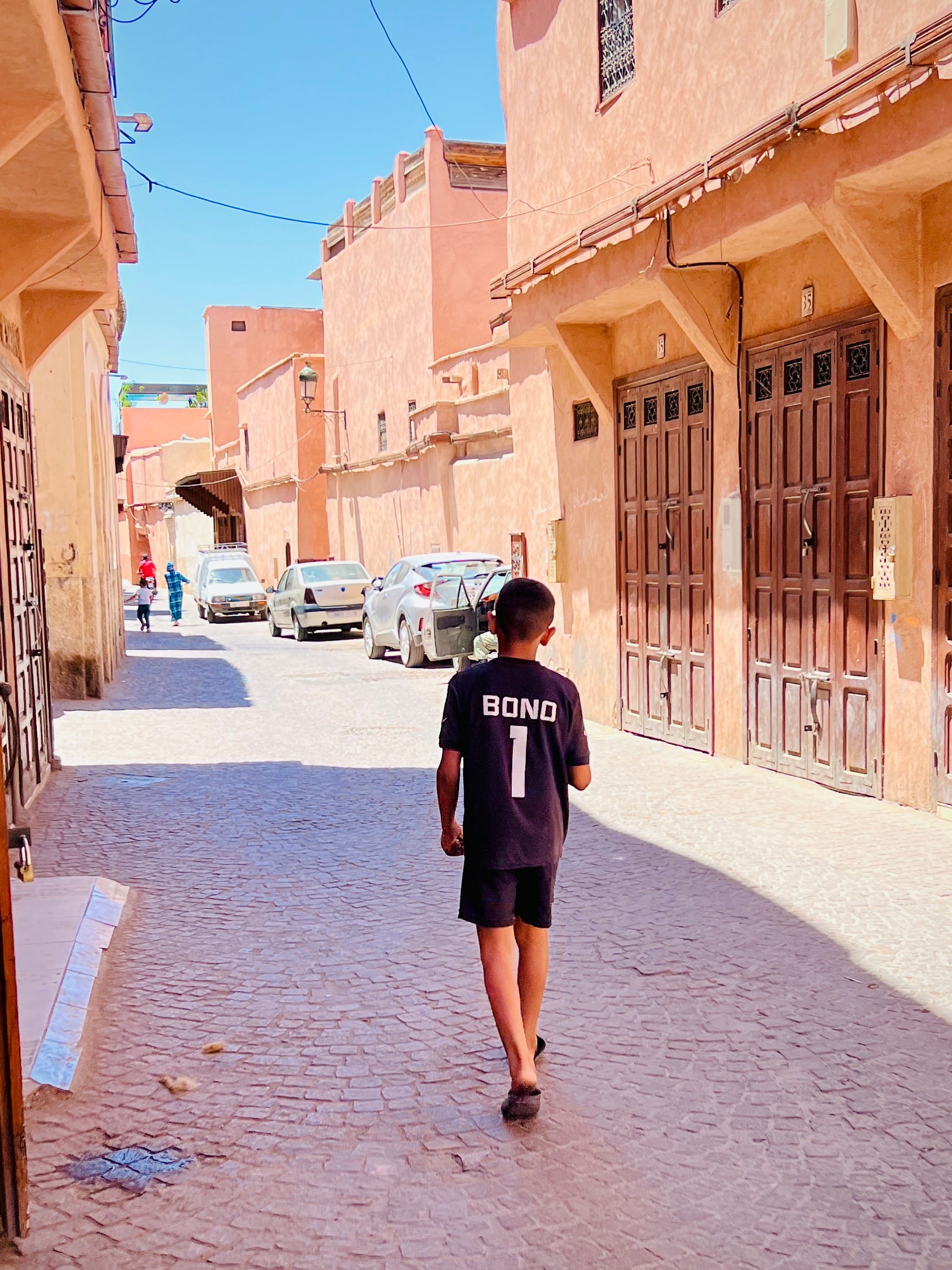
And somewhere, a child will be wearing Amrabat, Bono or Díaz on the back of their shirt.
That is where football returns here after every major tournament: to everyday life. Back onto the streets. Onto the walls. Into the city.
The significance of this team cannot be measured only in trophies, semi-finals or defeats. It also lives in the fact that Moroccan names now appear naturally on children’s jerseys. That nobody has to search for a Bono shirt anymore. That a country no longer sees itself merely represented on the pitch, but recognised.
That an entire generation has stopped seeing itself as an extra in somebody else’s football story.
The final whistle ends the match. Not what remains afterwards.
_____________
Hi, I’m Emilia – a Berliner living in Marrakech, creator of Marrakech Art Tour and co-editor of L7YOUT – Graffiti & Street Art in Marrakech (328 pages, Marrakech 2025).
My PDF-Guides for independent travelers in Marrakech are available here.
Thanks for reading The Marrakech Diaries! You can support by showing me you’re here. Leave a like, a comment, spark a conversation or share this post with someone who’d enjoy it!
Beautiful to see all the celebrations happening in the streets, which become spaces lived in by everyone again.